Book Review: Yesteryear

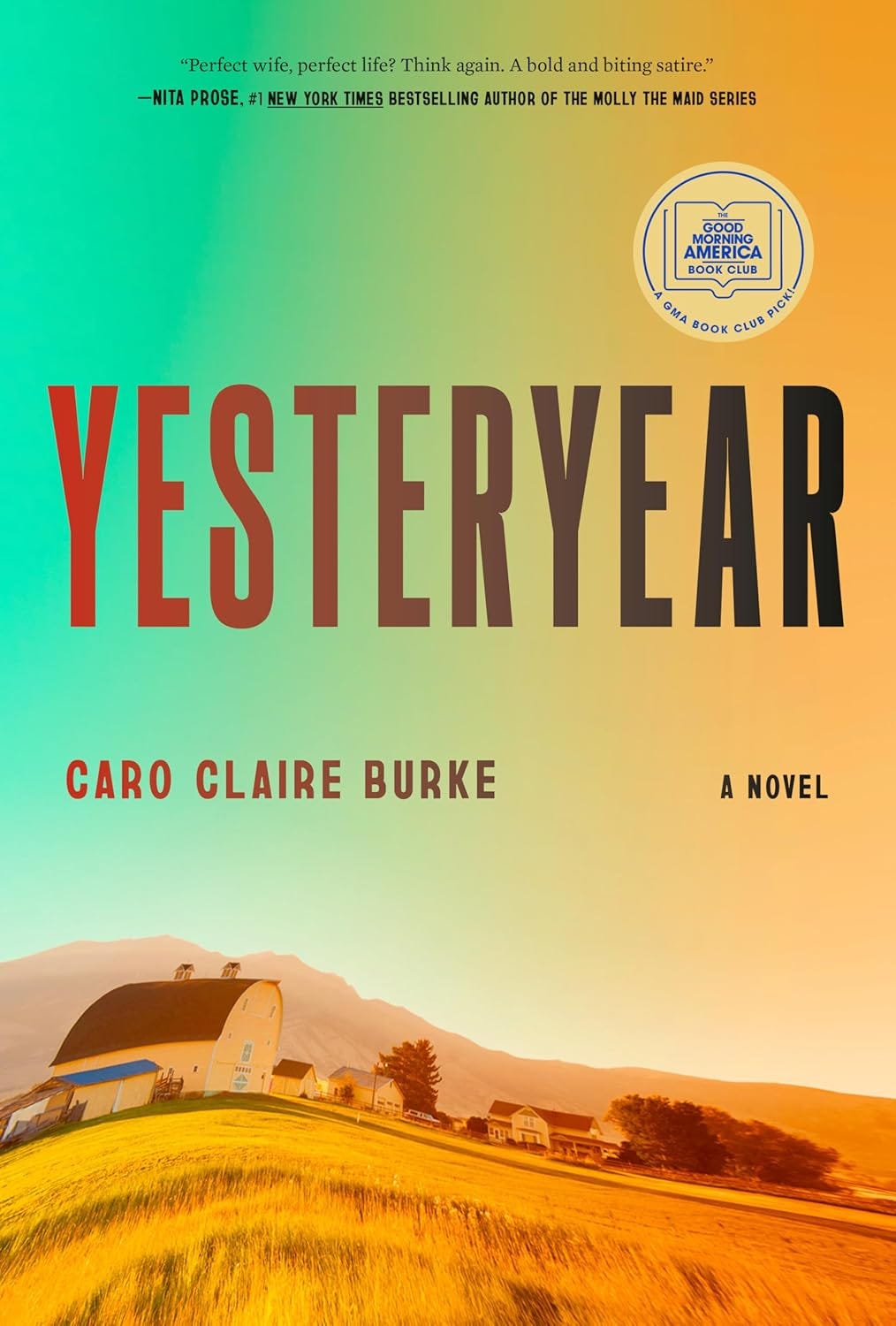
Yesteryear by Caro Claire Burke (Knopf, 2026).
Even though it’s a massive bestseller, many readers and reviewers whom I like and respect strongly disliked Caro Claire Burke’s new novel, Yesteryear. So although the subject matter sounded interesting enough to convince me to try it, I went in with low expectations.
And then I found myself mesmerized.
Yesteryear, as you may already have heard, tells the story of Natalie Heller Mills, a tradwife influencer who has built up a massive following by presenting a picture-perfect version of her family and her farm on Instagram. Then one day she wakes up to a harrowingly real, 19th-century version of the farm life she’s been promoting: plain prairie dresses instead of cashmere sweaters, butter that has to be churned by hand instead of by mixer, no nannies or doctors or help of any kind, and most distressing of all, a family that looks vaguely but not exactly like hers. Did Natalie time-travel, or did someone behind the scenes create an elaborate ruse and plunk her down in the middle of it? And how can she ever get back to her old prosperous reality?
I’m going to do something a little different here from what I usually do in a book review, and address some of the criticisms of the book, because a lot of them are thoughtful and well-reasoned criticisms, not unthinking backlash. I think they deserve to be addressed seriously (though I’ll have to keep it relatively brief) at the same time that I’m defending my own appreciation of the novel.
To start, the premise of Yesterday seems to promise schadenfreude for those weary of hearing from various cultural voices that the world would be perfect if only every woman were a pretty, sweet, subservient farmwife raising lots of babies on raw milk. Let’s be honest: The idea of one of the artful influencers who parrot that line having to live the messy farm life that our great-grandmothers knew is utterly delicious.
So I’ve been seeing some disappointment that there isn’t actually a lot of schadenfreude on offer. While trapped in the wrong century, Natalie doesn’t spend much time learning her lesson or mending her ways. It’s not that sort of story. It’s deeper than that, and ultimately, I believe this depth makes for a better book than the one so many of us were expecting. This nightmare scenario isn’t some cosmic joke designed to help her course-correct, but the logical culmination of everything that Natalie has spent years creating. She has built a monster that’s raging out of control.
Another widespread criticism is that it’s hard to figure out exactly what Natalie believes, or just how fervently she believes it. My friend Amy Colleen explains this issue best, and I recommend her review—for AFTER you’ve read the book, if you intend to read it, because she needed to share some big spoilers to make her argument. Although we came to very different conclusions about the book’s merit, her critique is well-expressed and worth reading. Here’s a sample of it:
Is Natalie Pentecostal, with her long uncut hair? Is she Catholic, “blessing herself” before prayer and refusing to use birth control and watching her mother chug hard liquor (??) at church functions? … Is she Baptist, with a total-immersion adult baptism that somehow bizarrely happened just before she went to college despite having been raised in this nebulous unnamed faith? Is she Anglican, since she references a priest and not a pastor? Is she Mormon, living with her handsome blond husband from a political family, in a region of Idaho that does not actually exist? … What Christian denomination believes that denying your child siblings is child abuse? The girls in her Harvard dorm are unsure of Natalie’s exact beliefs. Caro Claire Burke isn’t—she planned it this way.
All these details are accurate. (Natalie’s Harvard classmates alternately describing her as Amish and Orthodox Jewish and Mormon is one of the book’s funniest running gags.) To my mind, this would be more of a problem if Yesteryear had been the very specific satire so many of us thought it would be: the tale of one easily identifiable woman (a number of readers believe she’s a parody of the Ballerina Farm matriarch) having to put her money where her mouth is.
But that’s not what Yesteryear is. It’s more a reflection of broader cultural trends, and as such, it’s picking up on a certain blurriness of boundaries that very much exists in real life. One could point to, say, the Institute in Basic Life Principles, famously followed by the Duggar family, as an example of a belief system stitched together out of tenets and practices from various denominations. Many reality-show stars and online influencers have popularized the kind of religious mashup that Burke gives us here.
As to Natalie’s devoutness, or lack thereof, I understand that criticism too. Natalie diligently goes through the motions of faith, speaks the language of faith, all while she’s operating with a cool, selfish ruthlessness that even her piety can’t always disguise. “WHY IS IT SO HARD FOR YOU TO BE KIND?” snaps her exasperated mother as the book nears its climax, having let her own pious act erode to the point where she can finally vent her frustrations.
So does Natalie believe or doesn’t she? Well, once again, I didn’t have any trouble buying that even a person of faith could act like this. Once again, Burke is picking up on a prevalent and boundary-blurring trend: the devout mean girl.
After all, our cable channels and Instagram feeds are full of pretty pundits flashing sugary smiles as they say poisonous things in their perky baby voices. It’s a whole political aesthetic now. Furthermore, which of us couldn’t name several prominent religious men who, like Natalie’s husband, Caleb, went through the pipeline from “Western culture has become too feminized and men are suffering” to “all women should stay home and raise multitudes of children for the fatherland” to “women shouldn’t vote, or speak, or think”?
No, Natalie is not a nice person, and she freely shows us readers that she is not a nice person, and yet so skillfully is she depicted that her personality, her dilemma, her voice kept me riveted. As she struggled for power with her sad-sack yet equally ruthless husband, as she cunningly pitted herself against the “Angry Women” among her audience whom she constantly pictured watching her perform, I couldn’t wait to see what she would do next.
And at the same time we see her trying hard to pretend to be nice for her own world, we also see her having varying degrees of success with different people, and we see the odd glimpse of their varying reactions coming through, sometimes better than Natalie sees it herself. Successfully constructing all these layers is a real feat of writing, plus a refreshing antidote to the all-too-common kind of storytelling that wimps out at portraying genuine badness (“The Mistress of All Evil was just misunderstood!”)
In the end, I can sum up the achievement of Yesteryear in one anecdote. A critique of the novel that especially interested me was written by a self-described tradwife influencer (I won’t name or link to her here, as I’m not trying to be petty, just trying to make a point), who would seem to have the best right of all to protest Burke’s portrayal of her calling. Tradwives are not like that at all, this woman wrote. They are full of love and sweetness. They only want to honor God and care for their families and make wonderful meals for everyone. They would make you a wonderful meal if you visited them.
After I finished reading her piece, out of curiosity, I went to look at her Instagram. Full of love and sweetness, right? Not exactly. It was full of videos criticizing other women.
You see, Burke really isn’t that far off-base.
(Cover image courtesy of Knopf.)
Book Links:
Yesteryear on Amazon
Yesteryear on Bookshop
(Note: As an Amazon Associate I earn from qualifying purchases.)
Goodreads Links:
Family Drama by Rebecca Fallon
The Secret History by Donna Tartt
Life Studies by Susan Vreeland
Other Links:
For Christ and Pop Culture, I reviewed Weathering Change: Seeking Peace amid Life’s Tough Transitions by Courtney Ellis.
you did a good job with this review and I still disliked the book 😆
This is on my TBR list and this is the first thorough review I’ve read on it. Very interested to see how I’ll feel about it. Great job, Gina!